
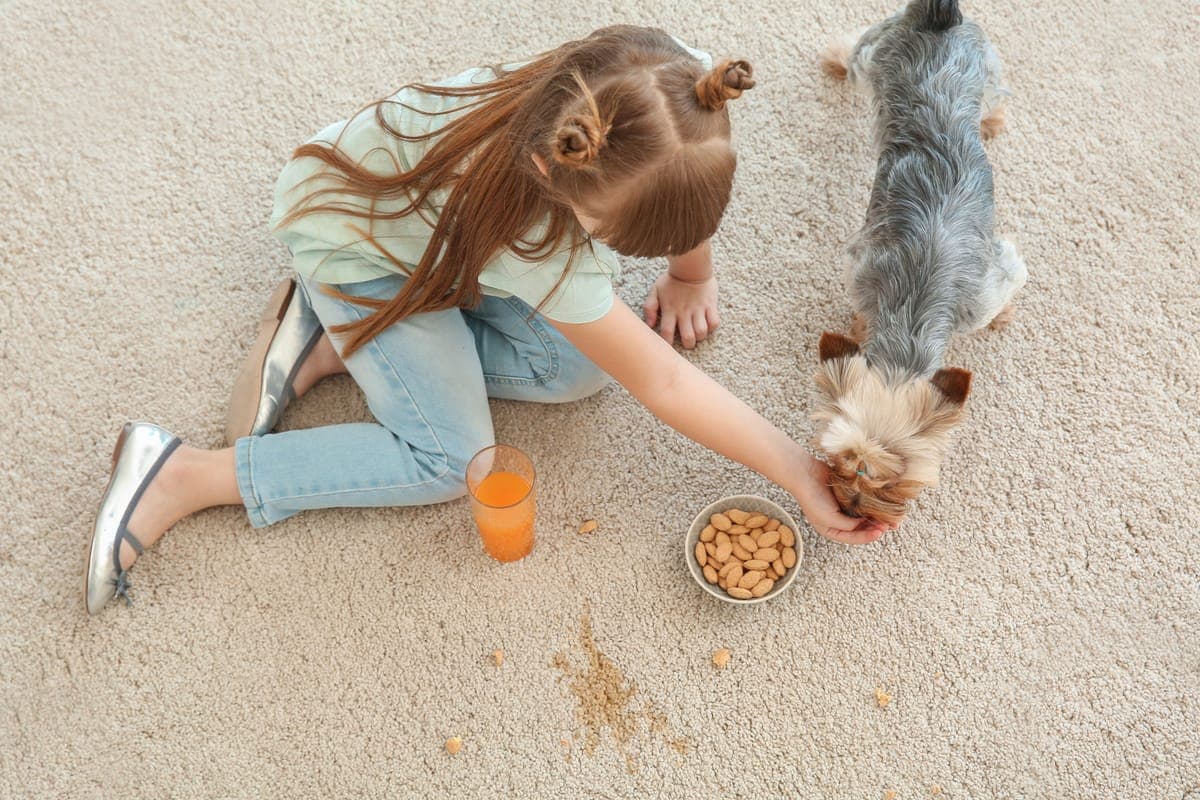
Almost every pet owner has lived this exact sequence. You find the accident, you blot it, you spray something that smells like citrus, and the room reads clean. For three or four days, everything is fine. Then the weather shifts, a damp afternoon settles in, and the smell is back like you never touched it. It feels like the cleaning failed. It didn't. The smell came back because of what was left behind in a layer you can't see.
The smell lives below the surface, not on it
When a pet has an accident, the liquid doesn't politely sit on top of the carpet. It moves. Gravity pulls it through the face fibers, into the backing, and down into the pad underneath. On hard-traffic spots it can reach the tack strip and even the subfloor. By the time you're wiping the surface, most of the urine has already migrated to a depth your towel and your spray bottle will never reach.
That gap between where you clean and where the urine actually went is the whole problem. The visible stain and the source of the odor are two different things in two different places. Lift the stain and the carpet looks done. The source is still sitting in the pad, untouched.
Uric acid crystals are the part that keeps coming back
Urine is a mix of water, urea, and uric acid, along with bacteria and salts. The water evaporates within a day. The urea breaks down and fades. Uric acid behaves differently. As the spot dries, the uric acid forms tiny crystals that bond tightly to the carpet backing and the fibers of the pad.
These crystals are stubborn for one specific reason: they don't dissolve in plain water. You can rinse, extract, and dry a spot until it looks immaculate, and the crystals stay right where they are. They are odorless while they sit there dry. That's why a treated spot can pass the sniff test for days at a time and convince you the job is finished.
Humidity is the trigger that resets everything
Here is the part that drives people up the wall. Uric acid crystals are hygroscopic, which means they pull moisture out of the air. When humidity climbs or the temperature rises, the crystals reactivate. They absorb moisture, the bacteria left behind get active again, and the reaction releases that sharp ammonia smell all over again.
This is why the odor seems to have a schedule. A muggy summer week, a steamy bathroom nearby, a spill, even a damp mopping of the floor can set it off. The smell isn't coming back from nowhere. It's the same original deposit getting re-triggered by moisture, releasing odor, drying out, and waiting to do it again. Cats make this worse than dogs because their urine is far more concentrated, so a cat spot packs a heavier crystal load into a smaller area. We get into that on our guide to removing cat urine from carpet.
The pet odor loop
Why surface cleaning never ends the smell
Accident soaks in
Urine passes through the carpet into the pad below.
It dries into crystals
Uric acid crystallizes and bonds to the backing and pad.
Humidity rises
A warm or damp day adds moisture back to the spot.
Crystals reactivate
Moisture wakes the uric acid and bacteria release ammonia.
The smell returns
You clean the surface again, and the loop starts over.
Safe-Dry® breaks the loop by converting the uric acid crystals into compounds that evaporate. With nothing left to reactivate, the smell does not come back.
Why air fresheners and fragrance sprays fail
Most over-the-counter odor products are built to cover, not to remove. They add a strong scent that sits on top of the urine smell. For a little while your nose registers the fragrance instead of the ammonia. But the crystals are still in the pad, so the underlying smell is still being produced. What you end up with is two smells layered together, and as the fragrance fades you're back to square one.
Vinegar and baking soda get recommended constantly, and they can knock a fresh smell down for a day. Neither one breaks the uric acid crystals apart, though. They mask and they buffer. They don't eliminate the thing generating the odor. Older spots that have been used repeatedly are the most resistant of all, which we cover in our piece on old, set-in pet urine stains.
What actually breaks the cycle
To stop the smell for good you have to do two things home methods skip. You have to treat the full depth of the contamination instead of just the surface, and you have to use something that chemically destroys the uric acid crystals rather than rinsing around them.
That's where pet urine restoration treatment comes in. Enzymes are biological catalysts that break the uric acid crystals down at the molecular level and convert them into compounds that simply evaporate. Once the crystals are gone, there is nothing left for humidity to reactivate. No source means no returning smell.
The other piece is mapping. A black light makes urine deposits glow, and the lit-up area is almost always bigger than the spot you remember cleaning. A Safe-Dry technician scans the area under UV first so the treatment covers the entire contaminated zone, then applies the enzyme to reach the same depth the urine reached. Because we neutralize the source instead of perfuming over it, the spot stays quiet on the next humid day. Our work comes with a 14-day odor guarantee, so if a treated odor returns in that window we come back. If you've been fighting the same spot for months, you can find your local Safe-Dry team and have it scanned and treated properly the first time.