
Dog Urine on Hardwood Floors
Hardwood looks sealed, but urine finds the gaps. Once it gets under the finish and into the wood, mopping just moves it around. Here's what's really going on below the surface.
Why the smell keeps coming back
People assume a sealed wood floor is waterproof, so they wipe up the puddle, run a damp mop over it, and call it done. The puddle is gone, but the floor was never as sealed as it looked. Every board meets its neighbor at a seam, and those seams are where urine slips below the finish almost immediately.
Mopping is actually part of the trap. Pushing a wet mop across the area spreads diluted urine into the surrounding seams and drives a little more of it down into the joints with each pass. You end up cleaning the top of a board while feeding the problem into the cracks you can't get a rag into.
And the popular home fixes can make it worse. Vinegar is acidic and dulls or etches a polyurethane finish over time. Hydrogen peroxide and bleach can lighten the wood unevenly, leaving a pale halo around a dark stain. Now you've got two kinds of damage instead of one, and the odor is still coming up through the seams.
On hardwood, the stain and the smell are two different problems. We can usually pull trapped odor out of the seams and subfloor; a black tannin stain in the grain is a refinishing job, and we'll tell you which one you've got.
What makes a hardwood different
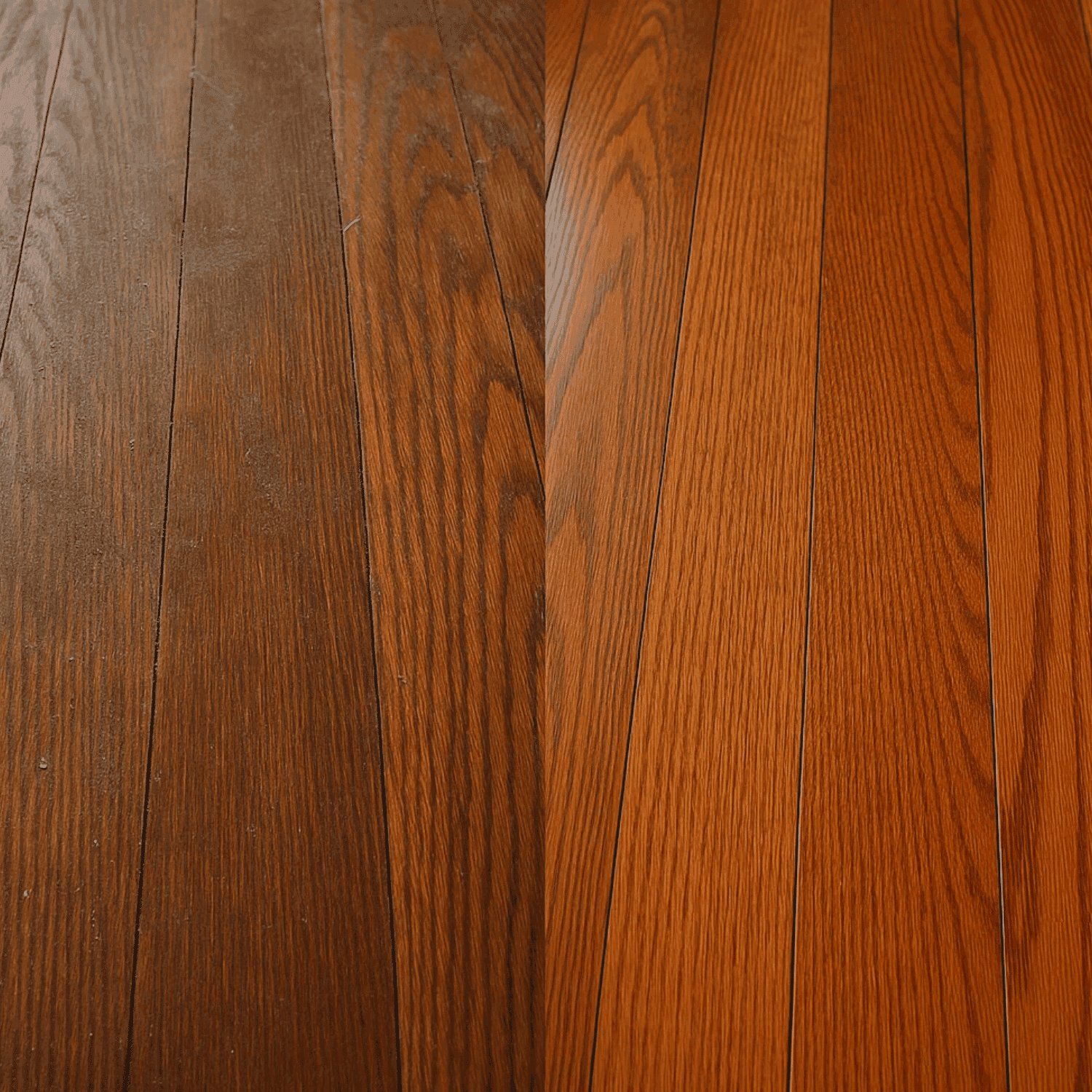
Hardwood fails at the edges, not the face. The finish on top of a board is reasonably tough, but it stops at every seam, gap, and nail hole, and that's where liquid goes. Urine wicks into the joint between boards, then into the raw end grain and the unsealed underside, soaking into wood that was never coated at all. From there it can reach the subfloor and even the joists. Two distinct kinds of damage follow, and they need to be told apart.
The first is the dark stain. Urine reacts with the tannins in the wood and with iron from nails and fasteners, producing the black or gray blotches that won't sand out because the discoloration runs deep into the grain. The second is moisture damage: repeated wetting makes boards swell and lift at the edges, the warp known as cupping, and on a glued or floating floor it can pop the finish or break the bond entirely. Sitting under all of it is the odor, and here's the part homeowners miss. The smell isn't on the floor you can see. It's trapped in the seams, the board undersides, and often the subfloor below, which is why a hardwood floor can look acceptable and still fill the room with ammonia on a humid day. Surface staining and trapped odor are two separate problems, and a floor can have one without the other.
How Safe-Dry® gets it out for good
First we find the true extent, because hardwood hides it well. Your technician uses UV light to map where urine has spread along the seams and a moisture reading to gauge how deep it went, then walks you through what we can realistically improve. The pet urine restoration treatment is worked into the seams and joints rather than smeared across the surface, so it reaches the trapped deposits in the end grain and on the board undersides where the odor actually lives. The enzymes break the uric acid down into compounds that evaporate, which kills the smell at its source instead of perfuming over it.
We're straight with you about the limits. Trapped odor in the seams and the subfloor is very often treatable, and that's where restoration work shines. Deep black tannin stains and boards that have already cupped or delaminated are a refinishing or replacement question, not a cleaning one, and we'll tell you plainly if that's where a spot has gone rather than sell you a treatment that can't deliver. Where the problem is odor, the result is backed by our 14-day odor guarantee, and your technician gives you a firm price after the inspection so you know exactly what you're paying for.
The same restoration treatment is explained in detail on our how enzyme treatment works page, and every job is backed by our 14-day odor guarantee.
Frequently asked questions
Can you get the black stains out of my hardwood?
Sometimes, but it depends on how deep they go. Black and gray stains come from urine reacting with tannins in the wood and iron in the fasteners, and that discoloration often runs well into the grain. Shallow staining can improve; a deep one usually needs sanding and refinishing, or board replacement if it's reached the subfloor. We'll assess it with you honestly before we start rather than promise a result the wood won't give.
Why can I smell urine when the floor looks fine?
Because the odor isn't on the surface you can see. Urine that slipped through the seams sits in the raw end grain, on the unsealed undersides of the boards, and often in the subfloor underneath. The finished top can look perfectly normal while that trapped deposit releases ammonia every time the air gets warm or humid. Reaching it means treating the seams, not the surface.
My boards are lifting at the edges. Can cleaning fix that?
No, and we won't pretend otherwise. Edges that have lifted, or cupping, is moisture damage from the wood swelling, and once boards have warped it's a repair or replacement issue rather than a cleaning one. What we can do is remove the trapped odor so a contractor isn't sanding into a floor that still smells. We'll flag the physical damage so you know what's a cleaning job and what's a carpentry job.
Is mopping with vinegar a bad idea on these spots?
It is. Vinegar is acidic enough to dull and etch a polyurethane finish over time, and mopping spreads diluted urine into the surrounding seams while pushing more of it down into the joints. You can end up with a damaged finish and a wider odor problem. For a urine spot, the seam is the target, not the face of the board, and that's not something a mop can reach.
Related pet odor problems we solve
Dog urine in carpet
A dog accident is mostly a volume problem. It soaks through to the pad and subfloor, so we treat it at full depth instead of just the surface.
SpecialOld, set-in stains
These deposits are years old, blotted on top but never cleaned below. UV light finds them; enzymes finally break them apart.
SpecialVomit & feces cleanup
Vomit and feces bring a stain, an odor, and bacteria all at once, so the spot gets cleaned and then sanitized with a step most DIY skips.
Ready to get the smell out for good?
Enter your zip code to reach your local Safe-Dry® team. We treat pet urine and odor across 523 locations in 6 states, with same-day appointments in most areas.